This post is for everyone in the world who enjoys awesome stuff.
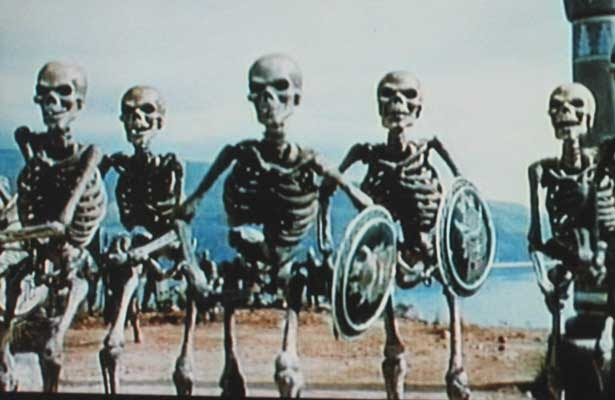
One of Ray Bradbury's close friends is Ray Harryhausen, a special effects wizzard who worked from the 50s through the early 80s. He did a lot of incredible stop motion animation. Here are a few clips. Enjoy.
Mighty Joe Young came after the success of King Kong:
20,000,000 Miles to Earth was part of the 1950's 'invaders from outer space' craze:
The Valley of Gwangi combined two of Hollywood's most successful genres, westerns and dinosaurs:
Jason and the Argonauts is arguably the best of Harryhausen's movies. It's just guys fighting lots of monsters:
Thursday, November 18, 2010
An Afternoon with Ray Bradbury
The following entry is for JUNIORS only.
Once read, his words are never forgotten. His best-known and most beloved books, THE MARTIAN CHRONICLES, THE ILLUSTRATED MAN, FAHRENHEIT 451 and SOMETHING WICKED THIS WAY COMES, are masterworks that readers carry with them over a lifetime. His timeless, constant appeal to audiences young and old has proven him to be one of the truly classic authors of the 20th Century -- and the 21st."
Ray Bradbury was born in 1920 in Waukegan, IL, just about 25 miles north of Glenview. He began publishing stories in magazines in 1939 as a teenager.
Bradbury "is one of those rare individuals whose writing has changed the way people think. His more than five hundred published works -- short stories, novels, plays, screenplays, television scripts, and verse -- exemplify the American imagination at its most creative.
Once read, his words are never forgotten. His best-known and most beloved books, THE MARTIAN CHRONICLES, THE ILLUSTRATED MAN, FAHRENHEIT 451 and SOMETHING WICKED THIS WAY COMES, are masterworks that readers carry with them over a lifetime. His timeless, constant appeal to audiences young and old has proven him to be one of the truly classic authors of the 20th Century -- and the 21st."
Your Task: Today you're going to spend some time with Ray. On his website here are posted several short videos of Bradbury being interviewed. Go ahead and watch at least six, particularly "Bradbury on Censorship," "Bradbury on Education," and "Bradbury on the Internet." Then, comment on your thoughts and reactions to at least two of the videos. Each of your comments should be entered as separate entries in the comments below. As always, for extra credit you may post additional entries in which you comment on your peers' ideas.
Tuesday, November 9, 2010
Southern Gothic
This post if for freshmen only.
Following are a few characteristics of gothic and southern gothic literature:
Southern Gothic
Literary Tradition
Gothic literature is fiction in which strange, gloomy settings and mysterious, violent, often supernatural events create suspense and terror. Southern gothic literature uses gothic motifs to explore social issues and reveal the cultural character of the American South.
Following are a few characteristics of gothic and southern gothic literature:
- The gothic novel tries to evoke chilling terror and gloom by exploiting mystery and horror. Gothic is about haunting and possession. We are supposed to feel a chill at some point in the story, and this emotional response is in part the point of the gothic experience. Paradoxically, this fear is a source of pleasure. "Tis so appalling--it exhilarates," Emily Dickinson says in a poem.
- In a Gothic work, there is usually confusion about good and evil. What does ‘good’ actually mean? What about ‘evil’? And how can we tell the difference?
- Gothic reveals a fear of institutions, such as religion, education, or marriage.
- Gothic shows the dark and hidden side of things. It rips open the lies and shows a world of cruelty, lust, perversion, and crime hidden beneath society’s rules and customs.
- Gothic tears through censorship and explodes hypocrisies. It exposes the world as a corrupt, reeking place.
- Gothic is a reaction to the conventional, common sense, and enlightened world. If society is supposed to be orderly and sensible, gothic shows how it really isn’t.
- Southern gothic tips stereotypes on their side and kicks them in the gut. Sweet Southern belles are crafty and greedy, chivalrous gentlemen are sneaky and perverse, and righteous preachers are manipulative and evil.
Your task: We've tackled three short stories that can be considered southern gothic - "The Lottery," "An Occurance at Owl Creek Bridge," "Good Country People" and "A Rose for Emily." Select one of the stories, and in a paragraph explain how one aspect of the story meets one of the criteria listed above. Be sure that your response is thoughtful and thorough and includes a cited quotation. Keep in mind all of the elements of a good paragraph: topic sentence, set-up, quotation, explanation.
Thursday, November 4, 2010
Banned!
Many years ago, when I began my teaching career in a small rural high school, the library was in a cage. Literally. The books were all locked inside a large metal cage in the corner of a study hall, and that was the library. At that time the library was staffed only one or two days a week, and I suppose it was considered necessary to lock it up for security. Still, I remember thinking that it was a great shame the students had so little access to the books. For most of the year, all of these books were essentially "banned."
But banning or censoring books is certainly not a new concept in any kind of library. All libraries have specific policies that are followed in selecting books for inclusion in the collection. Many libraries have very narrowly defined purposes, and books are only selected in those particular fields. Selection is also limited by funding and available shelf space, and often is age- and time-sensitive. For public schools, libraries have the very narrow function of having library collections that adequately support the curriculum.
Each year as Banned Books week arrives, I reflect on the ways the collection in my elementary school library has been censored. Every time I chose a book for our shelves it is done according to our school district selection policy, which says books must be age-appropriate and related to our school district curriculum. School librarians are, like all teachers, considered to be "in loco parentis" and are thus responsible for the safety of the children in their care. Over the years, I have developed a very fine collection of materials, but I have often "banned" books. That is my job, but we call what I do "selection," not "censorship." The hardest part of the job is to constantly keep in balance all viewpoints, not push my own agenda and remember that the education and safety of all of the students is my top priority. The exercise of the right to know must be tempered by a child's need for physical and emotional well-being.
Still, there is the very real issue of what to do when an individual parent asks that a book be banned from the library collection because he does not want his child to be exposed to it. Certainly, as patrons of that school district, parents do have that right. All school libraries have specific procedures that must be followed to review a contested book; when these are well crafted and followed meticulously, they usually work well. They allow for the school community's representative group to calmly review the book in light of the school's stated selection criteria and evaluate the book on its own merits.
Sometimes a book is removed. This usually happens because the selection criteria were not fully met or the process for reconsideration of materials was not followed, or if, upon reflection, the book is deemed to be inappropriate for that age level. In most cases, the complainants begin to look at the book in light of the whole process and realize that although they may not want their child to read a book such as "Bridge to Terabithia" by Katherine Paterson because it has several profanities, it is actually a very fine book that other parents might want their own children to read.
Several years ago, the mother of a Muslim child in our school asked that I not allow her son to check out any book about Christmas or other Christian holidays. She was not asking that those books be banned, only that her child be banned from reading them. But I could not ban her child from checking out Christmas books. She needed to do that with her child. Even small children can learn to evaluate materials and decide what is best for them to read or not. This is where teachers, librarians and parents have the very real responsibility to expose kids to only the very best in literature and the most fair and unbiased nonfiction materials.
In my library we teach very young children to try to read a page in their selected material. If they cannot read and understand five words in the first paragraph, the book is probably too hard for them to read by themselves. In this way, children will grow up to be discriminating adult readers. I remember my own daughter, who at the age of eight had already created several criteria to help her select recreational reading materials. She would not read any book in which the main character was older than she was at the time — actually, not a bad beginning criterion for a young child to have.
It's dangerous to think that the only banned books are the sometimes outrageous examples highlighted during Banned Books Week. All of us ban. Censorship abounds. It's more important for us to think about how we should be educating our students to make good choices, to know what is worthwhile and to be able to think logically and weigh all ideas in order to choose wisely. Books may no longer be kept in cages, but our students are still often being denied access to the materials they need. Educating discriminating readers today is the way to reduce the inappropriate censorship of tomorrow.
Sharon Coatney is the library media specialist at the Oak Hill School in Overland Park, Kans. She is a past president of the American Association of School Librarians (a division of the American Library Association), and has been a librarian in grade schools at all levels.
Texas: If You Can't Ban Books, Ban Authors
Phil Bildner, Time.com - Wednesday, Sep. 29, 2010
But this school year, there will be no such celebration of books. Not because of budget cuts, and certainly not because of lack of interest. This school year's teen literature festival has been canceled because of a string of events that followed the banning last month of best-selling young-adult author Ellen Hopkins — just in time for the controversy to ripen for Banned Books Week, which is commemorated during the last week of September. (See the top 10 banned books.)
Secular and religious authorities have been attempting to ban books ever since people have been writing them. In Germany, where Johann Gutenberg invented the printing press, the first official censorship office was established within decades of the innovation. In the U.S., Anthony Comstock, considered to be the pioneer of modern American censorship, persuaded Congress to enact the Comstock laws, which banned the mailing of materials found to be "lewd, indecent, filthy or obscene." Under those laws, the works of literary giants such as Ernest Hemingway, F. Scott Fitzgerald and John Steinbeck were censored. Nowadays, beloved characters ranging from Harry Potter to Captain Underpants are frequent targets of censorship.
But banning authors?
"Banning authors isn't the same as banning books, but the intent is the same," says Hopkins, whose most recent novel, Fallout, the final volume of her Crank trilogy, just debuted at No. 5 on the New York Times series list (which is devoted to series of three or more). The trilogy (which also includes Crank and Glass) has been lauded by educators and reviewers alike. Its popularity among teens is rooted in Hopkins' pull-no-punches story lines that tackle issues such as crystal-meth addiction, teen prostitution, suicide and incest. (See the 100 best novels of all time.)
But it's her no-holds-barred approach that has ignited the current controversy. Upon learning that Hopkins was scheduled to speak at this school year's festival, several parents complained to the school board. The superintendent, after consulting with the head librarian, instructed the festival's organizers to remove Hopkins from the roster and rescind the invitation.
Since her books are available in Humble libraries, and because she had appeared at high schools in the district last year, Hopkins was shocked by the snub. After much soul-searching, she reached out to the other young-adult authors who were scheduled to participate. Pete Hautman, who in years past had been disinvited from appearances elsewhere after his work was deemed "inappropriate," withdrew from the festival. Then, in a show of solidarity, Matt de la Pena, Melissa de la Cruz, Brian Meehl and Tera Lynn Childs all followed suit. The district, in turn, canceled the event altogether. "As authors," Hopkins recently blogged, "we must maintain a unified voice against the idea that one person, or even a few, has the right to decide for everyone else what they are allowed to read, or what information they can have access to."
Hopkins' banning and the resulting boycott lit up the blogosphere and social-network sites. Several industry publications rushed to the author's defense, and a letter of protest from six national organizations, including the National Coalition Against Censorship, the Society of Children's Book Writers and Illustrators and the National Council of Teachers of English, excoriated the superintendent for violating "basic constitutional principles." "Those kids surely lost out," Hopkins notes. "However, those same kids will now view censorship through completely different lenses, and I hope they understand why authors must defend the ability to write books without fear of would-be censors."
Hopkins' critics questioned whether a formal invitation had ever been extended and contended that a disappointed author was merely throwing a bruised-ego tantrum. Yet Hopkins says she had negotiated the terms of her appearance and received a confirmation e-mail from a festival coordinator. Still, her critics apparently saw little value in young people reading about such edgy and unpleasant topics.
"When middle school parents challenge books, it's often a last gasp to stay involved," says Camille Powell, a Houston area school librarian whose BookMoot website is a go-to destination for educators and kid lit aficionados. "Elementary schools are fairly responsive to parental input. However, the junior high transition years are frustrating and difficult for parents as their control over their children and the school gradually erodes."
Like many, Powell was disheartened by the turn of events in Humble. However, she remains hopeful that the festival can be salvaged and believes the opportunity exists for a valuable teaching moment. "There could be a forum," Powell says, "where parents would be able to ask questions, raise concerns and share views and opinions. What could be more worthwhile than an impassioned, thoughtful tussle over books and how they affect us?"
Hopkins says she'd welcome the chance to participate in such a discussion. "I would pay my own way," Hopkins says. "We need to take back the dialogue. A misguided few cannot be permitted to dictate what's best for an entire community. These young people are depending on us."
Mr. Cowlin here again. Here are a few questions for you to answer. You don't have to answer all of them - just make sure your entry is a thoughtful paragraph. Post your responses in the comments section. Be sure to include your name in order to receive credit. As usual, you can earn some extra credit for commenting on your peers' comments. (Each reaction should be posted separately.)
- Coatney, author of the first article, says, "It's dangerous to think that the only banned books are the sometimes outrageous examples highlighted during Banned Books Week. All of us ban." What are some ways "all of us ban"? Should we stop, or is banning necessary sometimes? (Be sure to include specific examples - real and theoretical - in your response.)
- Author Ellen Hopkins says that "As authors [...] we must maintain a unified voice against the idea that one person, or even a few, has the right to decide for everyone else what they are allowed to read, or what information they can have access to." Do you aree? Why or why not? Is there a time when an individual voice should decide what media others are allowed to read or view? (Be sure to include specific examples - real and theoretical - in your response.)
Thursday, October 28, 2010
Junior Grammar Notes - Apostrophes
There are two uses for apostrophes: (I) possession and (II) abbreviation.
I. Apostrophes for possession indicate something that belongs to someone or something.
Ex: The girl’s phone never stopped ringing.
Rule 1: To show possessive form of a noun, add apostrophe + ‘s’:
- The school’s library has many books.
- The dog’s collar was missing.
- The criminal’s excuse was awful.
Rule 2: To show possessive form of a plural noun that already ends in ‘s’, add only an apostrophe after the ‘s’:
- Two weeks’ work is not enough to pay for school when you’re in college.
- The dogs’ collars were missing.
- FYI: If you can hear the extra ‘s’ add it
- Charles’s apple was almost gone.
- The Jones’s babysitter told them she would never come back.
Rule 3: If the plural form of a noun does not end in ‘s’, add apostrophe + ‘s’ like you do with the singular form.
- The children’s room was a mess.
- The women’s nails were being polished.
- The men’s basketball games were starting.
II. Apostrophes for Compression indicate that a word has been shortened or compressed.
Ex: That wasn’t her phone. (= was not)
Rule: The apostrophe shows where a letter has been left out.
- Can’t = cannot
- Isn’t = is not
- Don’t = do not
- Wouldn’t = would not
Junior Grammar Notes - Colons and Semicolons
SEMICOLON
The Big Idea - When you have two complete thoughts about the same topic that are so closely related you don’t want to split them up with a period, the semi-colon is your friend (and helps you avoid dreaded run-ons).
SEMICOLON RULE 1
Semi-colons join two independent clauses (complete sentences) that are not connected with a coordinating conjunction (for, and, nor, but, or, yet, so).
- I really like Macbeth; it may be my favorite play ever.
- Macbeth cannot control his own personal life; the witches and Lady Macbeth take over.
SEMICOLON RULE 2
Semi-colons are used before a conjunctive adverb (also, besides, for example, however, in addition, instead, meanwhile, then, therefore, hence, moreover, after all, in fact). The second clause begins with the conjunctive adverb and a comma.
- I really like the storyline of Macbeth; however, I prefer the characters of Romeo and Juliet.
- Lady Macbeth understands her husband’s weaknesses; therefore, she knows how to get him to do what she wants.
COLON
The Big Idea - Use a colon to introduce an explanation, an example, an appositive, a list, or a quotation.
- At the baby’s one-month birthday party, Ah Po gave him the Four Valuable Things: ink, inkslab, paper, and brush (Kingston).
The words to the left of the colon need to form a complete sentence. DO NOT use a colon if the words to the left of it are not a complete sentence.
- Some natural fibers are: cotton, wool, silk, and linen.
Junior Grammar Notes - Confused Words
They’re, There, Their
- ’They’re’ refers to ‘they are.’
- ’There’ often refers to a place. If you take away the ‘t,’ it’s ‘here.’
- ’Their’ shows ownership.
Your and You're
- ‘You’re’ refers to ‘you are.’
- ‘Your’ shows ownership.
Its and It's
- It’s’ refers to ‘it is’ or ‘it has.’
- ‘Its’ shows ownership.
Affect (VERB) and Effect (NOUN)
- Affect is most widely used as a VERB meaning “to influence.”
- His decision affected the entire family.
- Her time in New Orleans affected her outlook on life.
- Effect is most widely used as a NOUN meaning “consequence, result, outcome.”
- I worried about the effect on his eyes.
- What effect will that have?
Whose and Who's
- ‘Who’s’ refers to ‘who is’ or ‘who has’ and is an apostrophe used for compression.
- ‘Whose’ shows possession.
Tuesday, October 26, 2010
Terrible Love Poems
THE HEART OF
THE BAD LOVE POEM
So we're going to write some love poetry. Awful, terrible love poetry. If you'd like some ideas before you dig in, continue reading below.
First, I have a few poems that are considered good love poems. Go ahead and read them and see if they give you any ideas.
A Red, Red Rose
by Robert Burns
O my Luve's like a red, red rose
That's newly sprung in June;
O my Luve's like the melodie
That's sweetly played in tune.
As fair art thou, my bonnie lass,
So deep in luve am I;
And I will luve thee still, my dear,
Till a' the seas gang dry:
Till a' the seas gang dry, my dear,
And the rocks melt wi' the sun;
I will luve thee still, my dear,
While the sands o' life shall run.
And fare thee weel, my only Luve,
And fare thee weel awhile!
And I will come again, my Luve,
Tho' it ware ten thousand mile.
To a Stranger
by Walt Whitman
PASSING stranger! you do not know how longingly I look upon you,
You must be he I was seeking, or she I was seeking, (it comes to me, as of a dream,)
I have somewhere surely lived a life of joy with you,
All is recall’d as we flit by each other, fluid, affectionate, chaste, matured,
You grew up with me, were a boy with me, or a girl with me,
I ate with you, and slept with you—your body has become not yours only, nor left my body
mine
only,
You give me the pleasure of your eyes, face, flesh, as we pass—you take of my beard,
breast,
hands, in return,
I am not to speak to you—I am to think of you when I sit alone, or wake at night alone,
I am to wait—I do not doubt I am to meet you again,
I am to see to it that I do not lose you.
Under the Harvest Moon
by Carl Sandburg
Under the harvest moon,
When the soft silver
Drips shimmering
Over the garden nights,
Death, the gray mocker,
Comes and whispers to you
As a beautiful friend
Who remembers.
Under the summer roses
When the flagrant crimson
Lurks in the dusk
Of the wild red leaves,
Love, with little hands,
Comes and touches you
With a thousand memories,
And asks you
Beautiful, unanswerable questions.
Longing
by Matthew Arnold
Come to me in my dreams, and then
By day I shall be well again!
For so the night will more than pay
The hopeless longing of the day.
Come, as thou cam'st a thousand times,
A messenger from radiant climes,
And smile on thy new world, and be
As kind to others as to me!
Or, as thou never cam'st in sooth,
Come now, and let me dream it truth,
And part my hair, and kiss my brow,
And say, My love why sufferest thou?
Come to me in my dreams, and then
By day I shall be well again!
For so the night will more than pay
The hopeless longing of the day.
By day I shall be well again!
For so the night will more than pay
The hopeless longing of the day.
Come, as thou cam'st a thousand times,
A messenger from radiant climes,
And smile on thy new world, and be
As kind to others as to me!
Or, as thou never cam'st in sooth,
Come now, and let me dream it truth,
And part my hair, and kiss my brow,
And say, My love why sufferest thou?
Come to me in my dreams, and then
By day I shall be well again!
For so the night will more than pay
The hopeless longing of the day.
Less than helpful? No problem. If you'd like some examples of what I'd consider pretty cheesy love poems, click through the numbers on this website here. They have a ton of heart shaped cheese.
Remember, all content must be appropriate for class. These are love poems, not lust poems. Keep it cheesy, but keep it clean.
Want some extra credit? Write and extra poem. Let's see just how bad you can get after a little practice...
The following post is for period 4 juniors only.
Read the following short story by Kurt Vonnegut (the same author as EPICAC), and then answer the question at the end.
HARRISON BERGERON
KURT VONNEGUT
The year was 2081, and everybody was finally equal. They weren’t only equal before God and the law. They were equal every which way. Nobody was smarter than anybody else. Nobody was better looking than anybody else. Nobody was stronger or quicker than anybody else. All this equality was due to the 211th, 212th, and 213th Amendments to the Constitution, and to the unceasing vigilance of agents of the United States Handicapper General.
Some things about living still weren’t quite right, though. April, for instance, still drove people crazy by not being springtime. And it was in that clammy month that the H-G men took George and Hazel Bergeron’s fourteen-year-old son, Harrison, away.
It was tragic, all right, but George and Hazel couldn’t think about it very hard. Hazel had a perfectly average intelligence, which meant she couldn’t think about anything except in short bursts. And George, while his intelligence was way above normal, had a little mental handicap radio in his ear. He was required by law to wear it at all times. It was tuned to a government transmitter. Every twenty seconds or so, the transmitter would send out some sharp noise to keep people like George from taking unfair advantage of their brains.
George and Hazel were watching television. There were tears on Hazel’s cheeks, but she’d forgotten for the moment what they were about.
On the television screen were ballerinas.
A buzzer sounded in George’s head. His thoughts fled in panic, like bandits from a burglar alarm.
“That was a real pretty dance, that dance they just did,” said Hazel.
“Huh?” said George.
“That dance – it was nice,” said Hazel.
“Yup,” said George. He tried to think a little about the ballerinas. They weren’t really very good – no better than anybody else would have been, anyway. They were burdened with sashweights and bags of birdshot, and their faces were masked, so that no one, seeing a free and graceful gesture or a pretty face, would feel like something the cat drug in. George was toying with the vague notion that maybe dancers shouldn’t be handicapped. But he didn’t get very far with it before another noise in his ear radio scattered his thoughts.
George winced. So did two out of the eight ballerinas.
Hazel saw him wince. Having no mental handicap herself she had to ask George what the latest sound had been.
“Sounded like somebody hitting a milk bottle with a ball peen hammer,” said George.
“I’d think it would be real interesting, hearing all the different sounds,” said Hazel, a little envious. “All the things they think up.”
“Um,” said George.
“Only, if I was Handicapper General, you know what I would do?” said Hazel. Hazel, as a matter of fact, bore a strong resemblance to the Handicapper General, a woman named Diana Moon Glampers. “If I was Diana Moon Glampers,” said Hazel, “I’d have chimes on Sunday – just chimes. Kind of in honor of religion.”
“I could think, if it was just chimes,” said George.
“Well – maybe make ‘em real loud,” said Hazel. “I think I’d make a good Handicapper General.”
“Good as anybody else,” said George.
“Who knows better’n I do what normal is?” said Hazel.
“Right,” said George. He began to think glimmeringly about his abnormal son who was now in jail, about Harrison, but a twenty-one-gun salute in his head stopped that.
“Boy!” said Hazel, “that was a doozy, wasn’t it?”
It was such a doozy that George was white and trembling and tears stood on the rims of his red eyes. Two of the eight ballerinas had collapsed to the studio floor, were holding their temples.
“All of a sudden you look so tired,” said Hazel. “Why don’t you stretch out on the sofa, so’s you can rest your handicap bag on the pillows, honeybunch.” She was referring to the forty-seven pounds of birdshot in canvas bag, which was padlocked around George’s neck. “Go on and rest the bag for a little while,” she said. “I don’t care if you’re not equal to me for a while.”
George weighed the bag with his hands. “I don’t mind it,” he said. “I don’t notice it any more. It’s just a part of me.
“You been so tired lately – kind of wore out,” said Hazel. “If there was just some way we could make a little hole in the bottom of the bag, and just take out a few of them lead balls. Just a few.”
“Two years in prison and two thousand dollars fine for every ball I took out,” said George. “I don’t call that a bargain.”
“If you could just take a few out when you came home from work,” said Hazel. “I mean – you don’t compete with anybody around here. You just set around.”
“If I tried to get away with it,” said George, “then other people’d get away with it and pretty soon we’d be right back to the dark ages again, with everybody competing against everybody else. You wouldn’t like that, would you?”
“I’d hate it,” said Hazel.
“There you are,” said George. “The minute people start cheating on laws, what do you think happens to society?”
If Hazel hadn’t been able to come up with an answer to this question, George couldn’t have supplied one. A siren was going off in his head.
“Reckon it’d fall all apart,” said Hazel.
“What would?” said George blankly.
“Society,” said Hazel uncertainly. “Wasn’t that what you just said?”
“Who knows?” said George.
The television program was suddenly interrupted for a news bulletin. It wasn’t clear at first as to what the bulletin was about, since the announcer, like all announcers, had a serious speech impediment. For about half a minute, and in a state of high excitement, the announcer tried to say, “Ladies and gentlemen – ”
He finally gave up, handed the bulletin to a ballerina to read.
“That’s all right –” Hazel said of the announcer, “he tried. That’s the big thing. He tried to do the best he could with what God gave him. He should get a nice raise for trying so hard.”
“Ladies and gentlemen” said the ballerina, reading the bulletin. She must have been extraordinarily beautiful, because the mask she wore was hideous. And it was easy to see that she was the strongest and most graceful of all the dancers, for her handicap bags were as big as those worn by two-hundred-pound men.
And she had to apologize at once for her voice, which was a very unfair voice for a woman to use. Her voice was a warm, luminous, timeless melody. “Excuse me – ” she said, and she began again, making her voice absolutely uncompetitive.
“Harrison Bergeron, age fourteen,” she said in a grackle squawk, “has just escaped from jail, where he was held on suspicion of plotting to overthrow the government. He is a genius and an athlete, is under–handicapped, and should be regarded as extremely dangerous.”
A police photograph of Harrison Bergeron was flashed on the screen – upside down, then sideways, upside down again, then right side up. The picture showed the full length of Harrison against a background calibrated in feet and inches. He was exactly seven feet tall.
The rest of Harrison’s appearance was Halloween and hardware. Nobody had ever worn heavier handicaps. He had outgrown hindrances faster than the H–G men could think them up. Instead of a little ear radio for a mental handicap, he wore a tremendous pair of earphones, and spectacles with thick wavy lenses. The spectacles were intended to make him not only half blind, but to give him whanging headaches besides.
Scrap metal was hung all over him. Ordinarily, there was a certain symmetry, a military neatness to the handicaps issued to strong people, but Harrison looked like a walking junkyard. In the race of life, Harrison carried three hundred pounds.
And to offset his good looks, the H–G men required that he wear at all times a red rubber ball for a nose, keep his eyebrows shaved off, and cover his even white teeth with black caps at snaggle–tooth random.
“If you see this boy,” said the ballerina, “do not – I repeat, do not – try to reason with him.”
There was the shriek of a door being torn from its hinges.
Screams and barking cries of consternation came from the television set. The photograph of Harrison Bergeron on the screen jumped again and again, as though dancing to the tune of an earthquake.
George Bergeron correctly identified the earthquake, and well he might have – for many was the time his own home had danced to the same crashing tune. “My God –” said George, “that must be Harrison!”
The realization was blasted from his mind instantly by the sound of an automobile collision in his head.
When George could open his eyes again, the photograph of Harrison was gone. A living, breathing Harrison filled the screen.
Clanking, clownish, and huge, Harrison stood in the center of the studio. The knob of the uprooted studio door was still in his hand. Ballerinas, technicians, musicians, and announcers cowered on their knees before him, expecting to die.
“I am the Emperor!” cried Harrison. “Do you hear? I am the Emperor! Everybody must do what I say at once!” He stamped his foot and the studio shook.
“Even as I stand here –” he bellowed, “crippled, hobbled, sickened – I am a greater ruler than any man who ever lived! Now watch me become what I can become!”
Harrison tore the straps of his handicap harness like wet tissue paper, tore straps guaranteed to support five thousand pounds.
Harrison’s scrap–iron handicaps crashed to the floor.
Harrison thrust his thumbs under the bar of the padlock that secured his head harness. The bar snapped like celery. Harrison smashed his headphones and spectacles against the wall.
He flung away his rubber–ball nose, revealed a man that would have awed Thor, the god of thunder.
“I shall now select my Empress!” he said, looking down on the cowering people. “Let the first woman who dares rise to her feet claim her mate and her throne!”
A moment passed, and then a ballerina arose, swaying like a willow.
Harrison plucked the mental handicap from her ear, snapped off her physical handicaps with marvelous delicacy. Last of all, he removed her mask.
She was blindingly beautiful.
“Now” said Harrison, taking her hand, “shall we show the people the meaning of the word dance? Music!” he commanded.
The musicians scrambled back into their chairs, and Harrison stripped them of their handicaps, too. “Play your best,” he told them, “and I’ll make you barons and dukes and earls.”
The music began. It was normal at first – cheap, silly, false. But Harrison snatched two musicians from their chairs, waved them like batons as he sang the music as he wanted it played. He slammed them back into their chairs.
The music began again and was much improved.
Harrison and his Empress merely listened to the music for a while – listened gravely, as though synchronizing their heartbeats with it.
They shifted their weights to their toes.
Harrison placed his big hands on the girl’s tiny waist, letting her sense the weightlessness that would soon be hers.
And then, in an explosion of joy and grace, into the air they sprang!
Not only were the laws of the land abandoned, but the law of gravity and the laws of motion as well.
They reeled, whirled, swiveled, flounced, capered, gamboled, and spun.
They leaped like deer on the moon.
The studio ceiling was thirty feet high, but each leap brought the dancers nearer to it. It became their obvious intention to kiss the ceiling.
They kissed it.
And then, neutralizing gravity with love and pure will, they remained suspended in air inches below the ceiling, and they kissed each other for a long, long time.
It was then that Diana Moon Glampers, the Handicapper General, came into the studio with a double-barreled ten-gauge shotgun. She fired twice, and the Emperor and the Empress were dead before they hit the floor.
Diana Moon Glampers loaded the gun again. She aimed it at the musicians and told them they had ten seconds to get their handicaps back on.
It was then that the Bergerons’ television tube burned out.
Hazel turned to comment about the blackout to George.
But George had gone out into the kitchen for a can of beer.
George came back in with the beer, paused while a handicap signal shook him up. And then he sat down again. “You been crying?” he said to Hazel.
“Yup,” she said,
“What about?” he said.
“I forget,” she said. “Something real sad on television.”
“What was it?” he said.
“It’s all kind of mixed up in my mind,” said Hazel.
“Forget sad things,” said George.
“I always do,” said Hazel.
“That’s my girl,” said George. He winced. There was the sound of a riveting gun in his head.
“Gee – I could tell that one was a doozy,” said Hazel.
“You can say that again,” said George.
“Gee –” said Hazel, “I could tell that one was a doozy.”
Your task: In the comments section below, select one of the following common sci-fi exigencies and explain how the exigence is the focus of the story. Be sure to support your claim with specific details from the story. As always, grammar, mechanics and spelling count.
Extra credit: Feel free to comment on your peer's entries.
- Our over-reliance on technology will lead to our dehumanization.
- Like Frankenstein’s monster, technology often destroys its creator.
- Super-realistic media blurs the line between fiction and reality.
- We often relinquish our right to be free-thinkers.
- We too often seek out diversions that merely grant instantaneous gratification and create an “automatic reflex.”
- Hyper-kinetic media strips us of our ability to focus and think.
- We can become too dependent on technology to perform common tasks that we should be able to perform with relative ease.
- We lose our ability to reason when we seldom practice that skill.
- Television make us dum.
- We allow small groups (or individuals) with loud voices to make decisions that, in part, determine the fate of the masses.
Subscribe to:
Posts (Atom)